Choose between helical and straight racks by the axis requirement, not by the idea that one tooth form is universally better. Straight teeth are geometrically simple and avoid a helical axial-force component. Helical teeth engage more gradually and are often considered where smooth, fast motion is important.
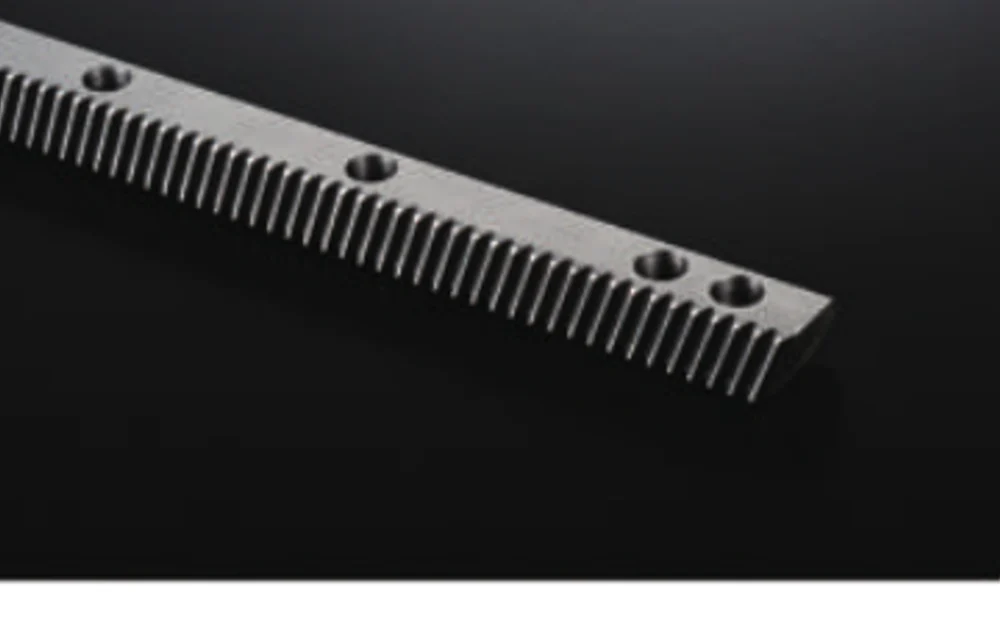
What changes when the teeth are helical?
With helical teeth, the mating pinion must match module, pressure angle, helix angle and hand. The more gradual engagement can support smoother running, but the helix also creates an axial load component that the bearings and gearbox arrangement need to manage.
Long-travel CNC axes, cutting gantries and fast automation often consider helical gear racks when smooth engagement is part of the design target. That does not remove the need to check mounting stiffness, backlash and lubrication.
Where straight racks remain practical
Straight racks suit a very wide range of positioning, lifting, material-handling and general machine mechanisms. They simplify tooth geometry and make the direction of tooth force easier to understand. In applications where speed and noise are moderate, a straight rack can be the most direct and economical choice.
Straight racks can also be ground when the machine needs better tooth finish or pitch control. Tooth form and manufacturing accuracy are separate decisions: “straight” does not automatically mean low precision, and “helical” does not automatically mean high precision.
Comparison by engineering question
| Engagement | Helical engagement is more gradual; straight engagement occurs along a simpler tooth line. |
|---|---|
| Axial force | Helical mesh creates an axial component; straight rack mesh does not create the same helix-related axial component. |
| Pinion compatibility | Both require matching module/pitch and pressure angle; helical systems additionally require matching helix angle and hand. |
| Manufacturing route | Both can be milled, hardened or ground depending on the required specification and process capability. |
| Installation | Both need a stable mounting datum and controlled rack joints; helix does not eliminate alignment work. |
| Typical decision input | Travel, speed, acceleration, load, duty, positioning/backlash target, environment and drive layout. |
Think about the gearbox and bearings
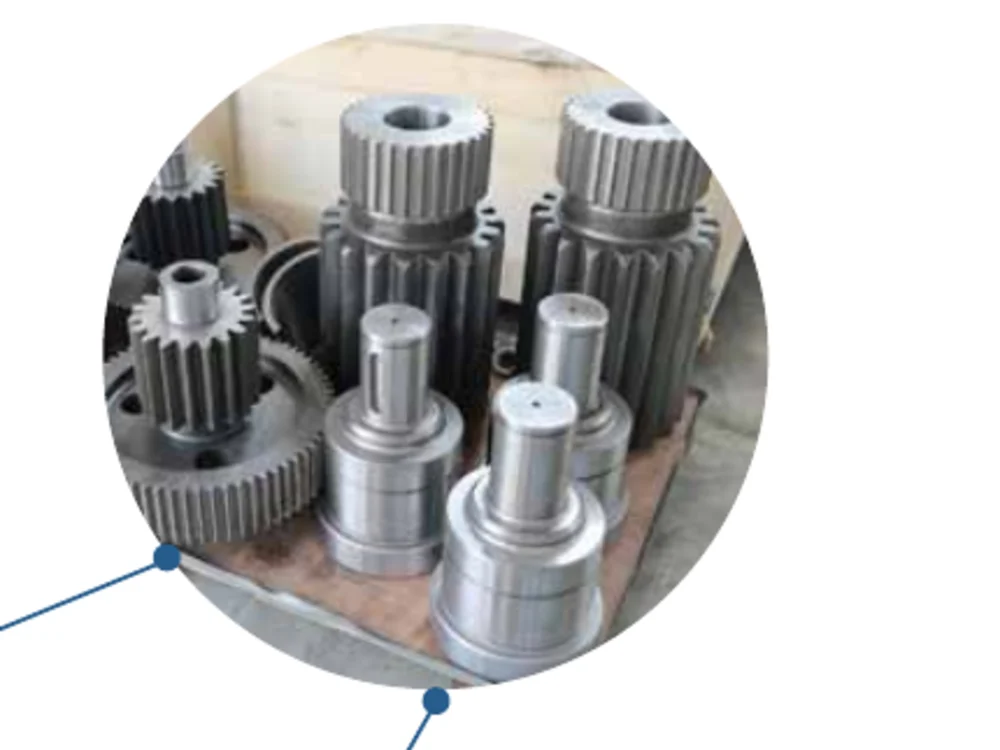
A pinion is normally attached to a gearbox output or supported shaft. In a helical drive, the axial component should be carried through a bearing arrangement that was designed for it. In a straight drive, the support still has to control radial load, torsional deflection and pinion alignment.
If a gearbox has already been selected, send the output-shaft or flange information with the rack RFQ. The pinion interface may decide which tooth count and mounting style are practical.
Use the application to make the final choice
For a laser-cutting gantry or robot travel axis, smooth high-speed reversal may push the design toward a helical system. For a lifting device or straightforward transfer axis, a straight rack may deliver everything the machine needs with less complexity. The correct answer comes from the complete motion brief, not from the tooth form name alone.
Envía los detalles que definen la pieza.
Un presupuesto útil comienza con la geometría y el contexto de funcionamiento. Envíe el plano, la cantidad y los requisitos de control; para ejes accionados por cremallera, añada el recorrido, la velocidad, la aceleración, la carga y la información del piñón o la caja de engranajes correspondiente, si está disponible.
Pedido: La cantidad mínima de pedido (MOQ) es flexible según el tipo de producto y el valor del pedido. Las muestras adecuadas para nuevos clientes pueden ser de 1 a 5 unidades; se admiten pedidos de modelos mixtos a partir de 1500 USD en total, mientras que se pueden considerar pedidos de 1 a 2 unidades a un precio unitario más alto.
Plazos y condiciones: El plazo de entrega habitual para piezas estándar es de 10 a 25 días laborables, para componentes personalizados de 20 a 45 días y para equipos de proyecto de 45 a 120 días. Los términos EXW, FOB, CIF y DAP son habituales; FCA, CFR, CPT, CIP y DDP pueden analizarse caso por caso.