A gear rack for a long machine axis should be selected from the motion requirement first, then from tooth size and manufacturing route. Travel, moved mass, acceleration, speed, duty and positioning requirements determine how demanding the rack-and-pinion set really is.
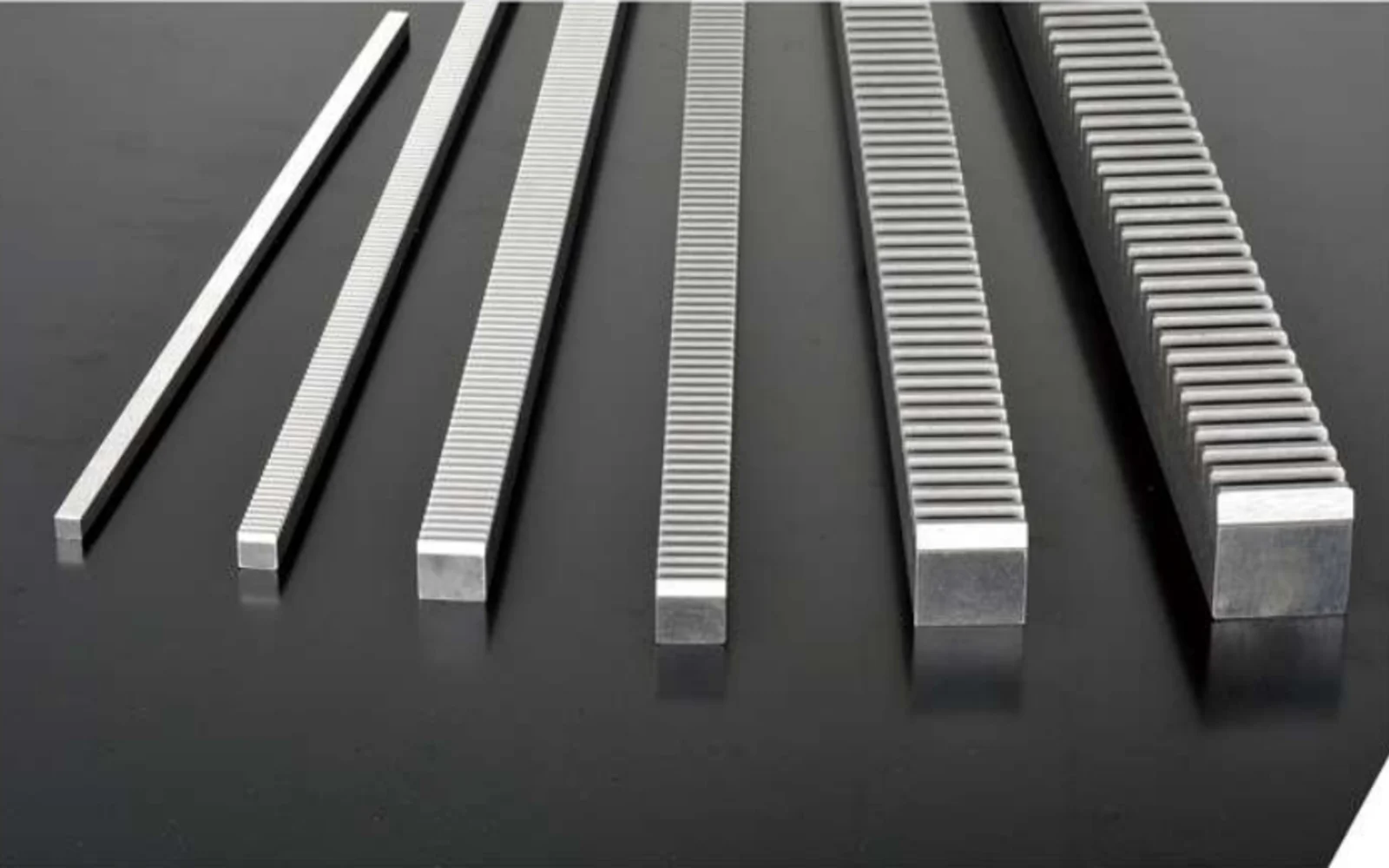
Start with the axis, not with module
Record whether the motion is horizontal or vertical, the total stroke, supported mass, external process force, maximum speed, acceleration and how often the axis reverses. On a long axis, also note how many rack sections will be joined and where the pinion sits relative to the guideways.
These values do not directly create a rack drawing, but they establish the duty. A rack chosen only because it has the same module as an old component can still be wrong for the desired speed, wear life, backlash or mounting arrangement.
Define the tooth system and the mating pinion together
| Module / pitch | Must match the pinion and should be checked against the force level and available tooth size. |
|---|---|
| Sudut tekanan | Use the released drawing or system standard; 20 degrees is a common industrial reference but should not be assumed blindly. |
| Bentuk gigi | Straight teeth simplify geometry; helical teeth can provide more gradual engagement but introduce an axial force component. |
| Pinion tooth count | Influences pitch diameter, linear travel per revolution and the gearbox/motor operating point. |
| Backlash setting | Depends on rack tooth thickness, pinion geometry, gearbox behaviour and the mechanical adjustment method. |
Choose the finishing route from the positioning requirement
Grinding is useful when the axis needs a tighter tooth finish or pitch control than a basic milled rack is intended to provide. It is not automatically necessary on every CNC or cutting axis. A hardened milled rack can be entirely appropriate on robust machinery where the control system and process do not demand a ground-tooth level of motion quality.
Ask what the machine actually needs: high rapid speed, repeatable positioning, low running noise, frequent reversal, long service life or simply a reliable way to move a heavy carriage. The answer points toward the right manufacturing route.
Long axes add an installation problem
A multi-section rack is only as good as the transition between adjacent sections. The mounting base, stop/datum surface and joining method should keep pitch continuity across the joint. A local step at the joint can be felt by the pinion every time it passes.
The guideway and rack datum also need to remain related over the full travel. If the rack moves closer to or farther from the pinion along the axis, backlash and contact change even when every rack section was manufactured correctly.
Do not leave lubrication until commissioning
Lubrication method, protection from chips/coolant and service access should be part of the machine layout. A precision rack operating dry or full of abrasive debris will not preserve its intended surface condition. The lubrication system should reach the active travel and be inspectable without dismantling major machine structures.
Prepare an RFQ that an application engineer can use
Send the rack drawing if it already exists. If the design is open, send the axis layout and the motion data, then identify which values are fixed and which can be selected. Include the proposed motor/gearbox and pinion data when available, plus quantity, material preferences and the accuracy or inspection requirement that matters to the machine.
Hantar butiran yang mentakrifkan bahagian tersebut.
Sebut harga yang berguna bermula dengan geometri dan konteks operasi. Hantar lukisan, kuantiti dan keperluan terkawal; untuk paksi pacuan rak, tambahkan maklumat pergerakan, kelajuan, pecutan, beban dan pinion atau kotak gear yang sepadan apabila tersedia.
Memesan: MOQ adalah fleksibel mengikut jenis produk dan nilai pesanan. Sampel pelanggan baharu yang sesuai boleh terdiri daripada 1-5 keping; pesanan model campuran disokong sekitar USD 1,500+ digabungkan, manakala 1-2 keping boleh dipertimbangkan pada harga seunit yang lebih tinggi.
Timing & terms: Bahagian standard biasanya 10-25 hari bekerja, komponen tersuai 20-45 hari bekerja, dan peralatan projek 45-120 hari bekerja. EXW, FOB, CIF dan DAP biasanya tersedia; FCA, CFR, CPT, CIP dan DDP boleh dibincangkan mengikut kes.